 blog
7 Exotic AIT Solutions Alternatives to Evaluate in 2026
Last Updated: November 5, 2026
Quick Summary
An exotic ait solutions alternative is a comparable provider of automation, CRM, or custom software work, judged on delivery model, scope, and total cost of ownership rather than marketing claims. Most buyers only need to choose between three delivery models: agency, platform, or freelancer.
- Score vendors on discovery depth, delivery ownership, integration scope, handover, commercial structure, and sector references.
- Synergy Business Group reports an average of 20+ hours saved per month and $18,500 saved annually per client.
- A real audit delivers a process map, ranked bottlenecks by hours lost, and a build sequence with owners and dates.
- Ask every vendor for a redacted audit sample, two client references, and a written handover sample.
- Name an owner for every automated workflow and review it after the first month of real usage.
Table of Contents
- What Buyers Actually Mean by an Exotic AIT Solutions Alternative
- Agencies, Platforms and Freelancers Are Not the Same Purchase
- How to Compare Automation Agencies Like for Like
- The Shortlist: Seven Exotic AIT Solutions Alternatives Compared
- Business Process Automation Consulting: What a Real Audit Delivers
- Workflow Automation Services That Survive Contact With Your Team
- CRM Optimization Services: Repairing the Pipeline You Already Own
- Custom AI Automation Solutions Without the Pilot-Project Graveyard
- Security, Privacy and Governance Questions to Ask Every Vendor
- Frequently Asked Questions
What Buyers Actually Mean by an Exotic AIT Solutions Alternative
Searching for an exotic ait solutions alternative usually means you want a different vendor for the same automation work, or a clearer picture of what a real automation partner should provide. This guide covers both, with a shortlist you can evaluate on equal terms.
Most buyers choose between three delivery models, not dozens of vendors. Get that classification right and the shortlist narrows fast.
Agencies, Platforms and Freelancers Are Not the Same Purchase
An agency takes responsibility for outcomes: audit, build, integration, and handover. A platform gives your team software to configure, with support but no delivery. A freelancer delivers specific build work at the lowest cost, with the least continuity.
If your bottleneck is unclear, an agency fits. If your process is defined and your team has capacity, a platform fits. If you need one integration built and documented, a freelancer can work. Buying the wrong model is why so many automation projects stall after the first month.
How to Compare Automation Agencies Like for Like
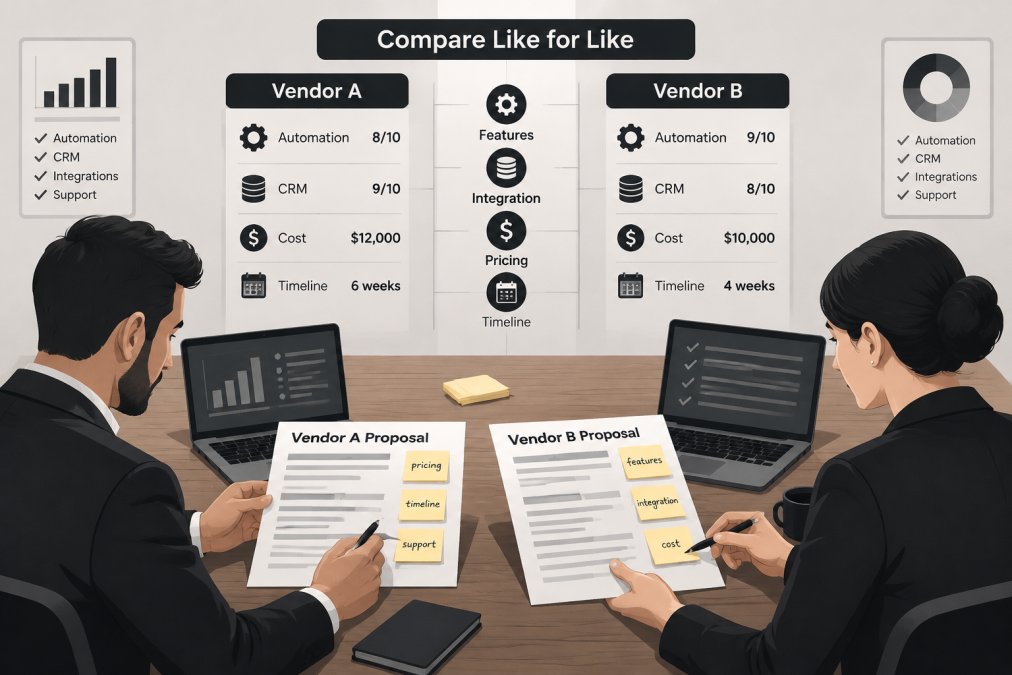
Score every candidate on the same criteria before you take a call.
Scoring Criteria That Separate Real Partners from Resellers
Use a simple weighted rubric. Score each item from one to five, then multiply by the weight.
- Discovery depth (weight 25%): do they audit your actual processes or send a template questionnaire?
- Delivery ownership (weight 20%): who builds, who tests, who fixes what breaks in month two?
- Integration scope (weight 20%): named systems they have connected before, not a list of logos
- Handover and documentation (weight 15%): what your team can run without them
- Commercial structure (weight 10%): fixed scope, retainer, or hourly, and what triggers overage
- References in your sector (weight 10%): comparable size and process complexity
A vendor scoring below three on discovery depth is a reseller with a nicer deck. Skip them. Proposals that quote a total without a defined scope grow after signature.
The Shortlist: Seven Exotic AIT Solutions Alternatives Compared
The seven options below cover the realistic delivery models for a small or mid-sized business.
**1.
2. In-house build. Your own operations lead configures the tools.
3. Freelance automation specialists. Individual builders on contract, strong for a single integration or a defined workflow.
4. Low-code platform vendors. Cloud-based tools your team configures with vendor support.
5. Enterprise systems integrators. Deep capability, long timelines, and budgets that suit larger organizations.
6. Offshore development shops. Custom development at lower rates, with project management overhead you carry.
7. Niche CRM consultancies. Focused on one platform's configuration and reporting. Commercial structure is usually a retainer or a fixed repair project.
Feature Comparison at a Glance
| Option | Delivery Model | Custom Build | Handover Depth | Commercial Structure | Best For |
|---|---|---|---|---|---|
| Synergy Business Group | Audit-led agency | Yes | Documented | Scoped per engagement | Messy, undocumented processes |
| In-house build | Internal | Limited | Internal only | Salary plus subscriptions | Teams with an ops hire |
| Freelance specialists | Contract build | Yes | Varies | Hourly or fixed scope | Single defined workflow |
| Low-code platforms | Software | Configure only | Self-serve | Subscription | Defined, simple processes |
| Systems integrators | Enterprise agency | Yes | Formal | Phased fixed scope | Complex migrations |
| Offshore shops | Contract build | Yes | Varies | Time-and-materials or fixed bid | Specified builds |
| CRM consultancies | Niche agency | Configure | Moderate | Retainer or fixed project | Single-platform repair |
Pros, Cons and Pricing Models for Each Option
Agency work is typically quoted as fixed scope, retainer, or hourly. Fixed scope suits defined projects; retainers suit ongoing optimization. For a worked breakdown, see how to budget custom workflow automation services.
-
Synergy Business Group: audit-led scope, documented handover, named integrations. Limitation: engagements are scoped, so there is no self-serve entry point.
-
In-house: lowest cash cost, highest opportunity cost, and continuity depends on one person.
-
Low-code platforms: predictable subscription, hidden configuration time, and connector limits.
-
Integrators and offshore shops: scale and rate advantages respectively, both with management overhead and change-order risk.
-
CRM consultancies: deep single-platform knowledge, limited cross-system scope.
For a direct head-to-head, read Hoop Interactive vs Growth Operators: 2026 Comparison, and for a wider benchmark see Growth Operators alternative: 7 options compared.
Evidence to Request From Every Shortlisted Vendor
Directory ratings and logo walls are not evidence. Ask each vendor for three things and compare the answers side by side. First, a redacted sample of a past audit or discovery deliverable, so you can see whether it is a process map or a slide deck. Second, two client references of comparable size and process complexity who will take a call without the vendor on the line. Third, a written handover sample showing the documentation, access controls, and runbook your team would receive. A vendor that cannot produce these is asking you to buy on trust alone.
Business Process Automation Consulting: What a Real Audit Delivers
A real audit produces three things: a process map of how work actually flows, a ranked list of bottlenecks by hours lost, and a build sequence with owners and dates. Anything less is a sales call with a document attached.
Ask what the audit output looks like before you sign. The audit is also where scope gets honest: it surfaces the manual steps nobody documented, which is usually where the hours are hiding. Book a business automation audit if you want that diagnostic step defined before any build work starts.
How to Evaluate an Audit Before You Buy One
Most buyers cannot tell a real audit from a sales call until the invoice arrives. Use these four tests on the sample deliverable every vendor should share.
- Does it name systems and steps, or categories? A real process map names the CRM, the spreadsheet, the inbox, and the handoff between them. A generic audit says "sales process" and stops there.
- Does it quantify hours by bottleneck? The ranked list should show estimated hours lost per month per bottleneck, with the assumption behind the estimate stated. If every bottleneck is "high impact," nothing is ranked.
- Does it separate quick wins from structural fixes? A useful audit tells you which fixes can ship in weeks and which need a build phase, so you can sequence spend against value.
- Does it include a handover plan? The build sequence should name who owns each step, what documentation will exist at the end, and what your team will be able to run without the vendor.
Watch out: an audit that recommends only the vendor's own services, with no build-versus-buy analysis, is a scope document for a sale, not a diagnosis.
What an Audit Engagement Usually Looks Like
Ask upfront whether the audit fee is standalone or credited, and get the answer in writing.
How the Audit Sets Scope and Price
The audit is the document that makes fixed-scope pricing possible. Once bottlenecks are ranked and the build sequence is agreed, the vendor can quote a defined project instead of an open-ended retainer. That is why proposals that quote a total without a defined scope grow after signature. If a vendor will not show you the audit output before quoting a build, you are being asked to price work that has not been defined. For buyers comparing agencies, the audit deliverable is the single most useful document to request, because it reveals how the vendor thinks, what they measure, and whether their recommendations survive contact with your actual process.
Workflow Automation Services That Survive Contact With Your Team
Automation fails when it is built around a process your team does not actually follow. The build has to match the work as performed, not the org chart's version of it.
Three habits keep workflow automation services usable. Name an owner for every automated workflow. Document the manual fallback for when a step fails. Review the workflow after the first month, because real usage always differs from the design session. Teams that skip the review end up with automations nobody trusts, and untrusted automation gets bypassed within a quarter.
CRM Optimization Services: Repairing the Pipeline You Already Own
Most businesses do not need a new CRM. They need the one they own configured so the pipeline reflects reality.
CRM optimization can cover repairing the pipeline you already own so it reflects how deals progress. A common mistake is buying another platform before auditing the current one. The data usually shows the problem is configuration and adoption, not the software.
Custom AI Automation Solutions Without the Pilot-Project Graveyard
Custom AI automation solutions fail for a predictable reason: they are scoped as experiments with no owner and no success measure. Pilots die quietly because nobody defined what "working" meant.
Treat AI work like any other build, defining the measure of success before you start. As documented in the Government of Canada's guidance on responsible AI use, governance and human oversight belong in the design, not the afterthought. Buyers evaluating vendors should also check the Office of the Privacy Commissioner of Canada's guidance on privacy and AI, since personal data in workflows brings obligations.
Security, Privacy and Governance Questions to Ask Every Vendor
Ask these before signature, and ask for written answers. Vague reassurance is an answer in itself.
- Where does our data sit, and who can access it?
- Which subcontractors touch our systems, and under what terms?
- What happens to our data and configurations if we end the engagement?
- How are credentials stored and rotated?
- What is the breach notification process and timeline?
- Can you show the documentation we would receive at handover?
Under Canada's Personal Information Protection and Electronic Documents Act, businesses handling personal information carry obligations that do not transfer to a vendor. Once your questions are ready, schedule a consultation and put them to us directly.
The real test of any exotic ait solutions alternative is not the pitch, it is whether the vendor can map your process, name the hours it costs you, and hand back something your team can run. Synergy Business Group offers custom workflow automation, CRM pipeline repair, and compliant HR and payroll workflows.
Frequently Asked Questions
What does Exotica IT Solutions actually do?
Compare any provider's stated scope against your own bottleneck. If your problem is a broken CRM pipeline or manual admin eating 20 hours a month, confirm whether the provider will diagnose what to automate first or only build what you specify. Confirm scope in writing before you compare quotes.
How do I choose an Exotic AIT Solutions alternative for my business?
Start with the bottleneck, not the vendor. List the three processes costing you the most hours each month, then check whether each candidate has delivered that specific fix before. Ask for a paid or fixed-scope audit, request two references in your industry, and confirm who owns the automations and data when the engagement ends. An exotic ait solutions alternative that cannot show you a working example of your exact use case is a gamble, however good the sales call felt.
Can an automation partner optimize my CRM and workflows without replacing my current tools?
Usually yes. Many CRM optimization projects can work inside the platform you already use. Ask any provider to state plainly whether they will reconfigure or migrate, and get the answer in the proposal. Ask any vendor to state plainly whether they will reconfigure or migrate, and get the answer in the proposal.
How long does implementation take and what does it cost?
Timelines depend on scope, so ask any provider for a timeline tied to your specific project. Pricing is scoped per engagement, so request a quote. Compare total cost of ownership across year one, including licences, build time and internal staff hours, not just the headline fee.